AI copywriting guide
How to Use AI to Write Marketing Copy That Actually Converts
AI can help you draft and test marketing copy faster, but it cannot supply the customer insight, proof, positioning, or judgment that makes copy persuasive. This guide shows you how to combine useful AI prompts with human editing and real performance testing.
Includes a reusable prompt framework, channel-specific prompts, a before-and-after example, privacy safeguards, and a final editing checklist.
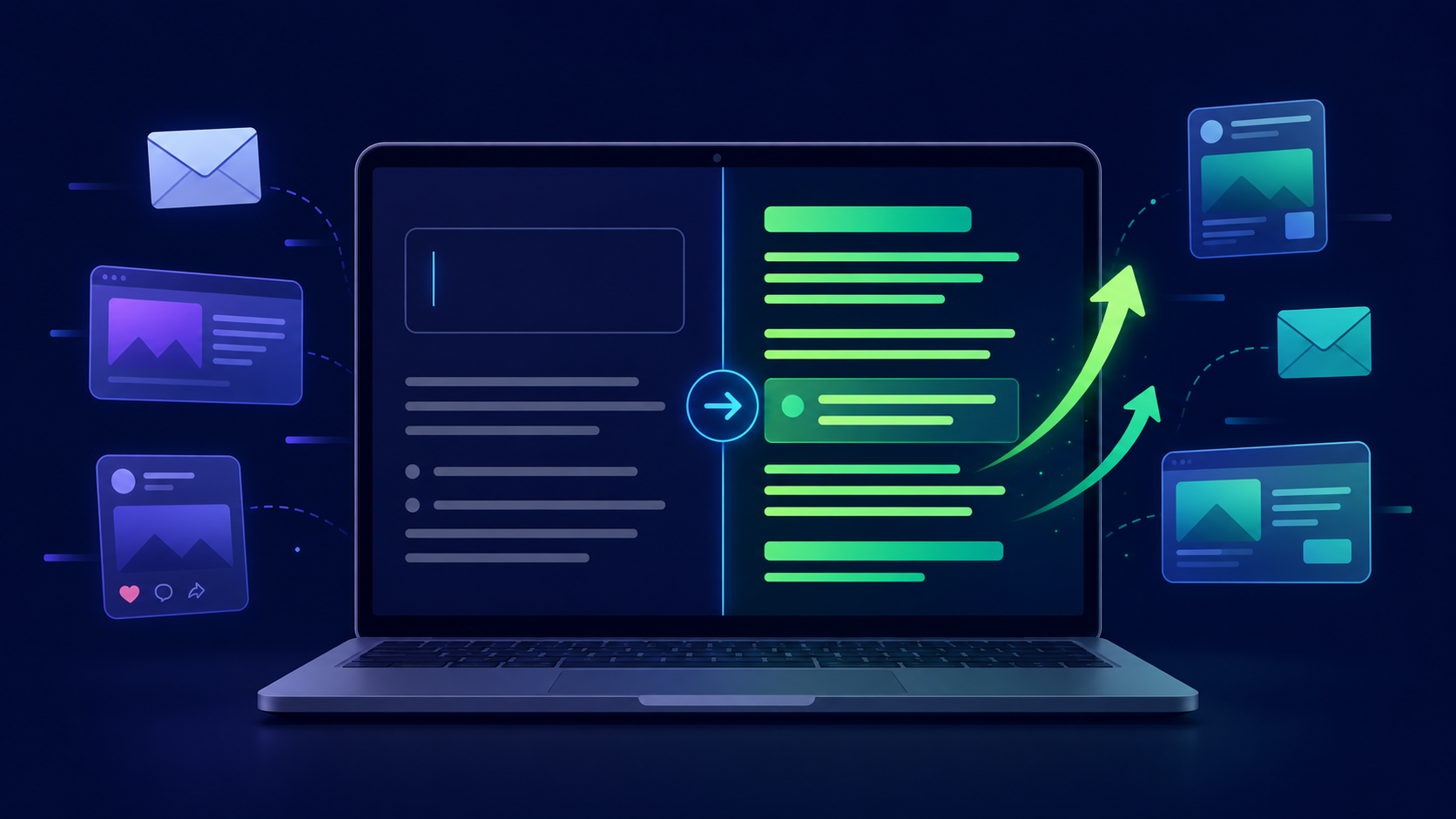
What AI Marketing Copy Can and Cannot Do
AI improves the production process. It does not guarantee better business results.
AI is good at generating options, reorganising information, adapting a message to different formats, and producing a usable first draft. That can shorten the distance between an idea and something you can review.
Conversion, however, depends on more than writing speed. The offer, audience, page experience, traffic source, price, proof, timing, and measurement setup all influence performance. A confident AI response is not evidence that the copy will work.
Use AI for
- First drafts and alternative angles
- Headline, hook, and call-to-action variations
- Adapting one message to several channels
- Summarising approved research or product details
- Finding vague language during editing
Do not ask AI to invent
- Customer results or testimonials
- Product features, prices, or guarantees
- Research findings or conversion statistics
- Legal, medical, or financial assurances
- Urgency that does not genuinely exist
Core principle: Treat AI as a drafting and variation tool. Your customer knowledge, approved facts, brand position, and test data must remain the source of truth.
Where AI Is Most Useful in Copywriting
The strongest use cases are repetitive, structured, and easy to review.
Message variations
Generate several hooks, headlines, subject lines, descriptions, and calls to action from the same approved brief. A human should shortlist the variations worth testing.
Format adaptation
Turn an approved landing-page message into an email, short ad, social caption, or sales follow-up without rebuilding the core argument each time.
Large product catalogues
Create structured first drafts from verified product attributes. Review every description for accuracy, duplication, restricted claims, and genuine differentiation.
Editing support
Ask AI to identify clichés, unclear claims, repeated ideas, weak calls to action, or passages that do not match the approved brand voice.
These uses save time because the output can be checked against a clear brief. High-stakes persuasion requires more human involvement because the cost of an inaccurate claim or a poor strategic decision is higher.
Where Human Judgment Still Matters Most
Good copy starts with decisions an AI model cannot make responsibly on its own.
Positioning
Choose the audience, problem, alternative, and reason your offer deserves attention.
Evidence
Decide which claims can be supported with product data, customer research, or documented results.
Ethics and risk
Remove misleading urgency, exaggerated outcomes, unsafe advice, and claims that exceed the evidence.
Customer empathy
Understand the hesitation behind a question and the language a real buyer would naturally use.
Brand voice
Recognise when a draft sounds unlike the company, even if it is grammatically polished.
Final approval
Confirm accuracy, relevance, compliance, and readiness before anything reaches the audience.
Collect These Inputs Before You Write the Prompt
Specific inputs produce more useful drafts than clever prompt wording alone.
Audience
Who is the reader, what situation are they in, and what do they already understand?
Problem and desired outcome
What is the immediate problem, and what realistic improvement does the reader want?
Offer and evidence
List only verified features, limitations, prices, proof, and differentiators the draft may use.
Customer language
Use anonymised phrases from research, interviews, reviews, support questions, or sales calls.
Channel and next action
Define where the copy will appear, the length constraints, and the single action the reader should take.
Privacy safeguard: Remove names, phone numbers, email addresses, account details, order information, and other identifying data before pasting reviews, WhatsApp messages, complaint logs, or sales-call notes into an AI tool. Follow your organisation's data policy and the tool's current privacy controls.
The Master Prompt Framework
Use one structured brief, then adapt it to each marketing channel.
Replace every item in square brackets. Delete any instruction that does not apply.
This framework reduces hallucinated proof because it limits the model to approved facts and explicitly asks it to flag claims for review. It also creates variations you can compare rather than treating the first answer as final.
AI Prompts for Facebook and Instagram Ad Copy
Generate distinct angles, then test them under comparable conditions.
Prompt: three ad angles
Prompt: turn a winning idea into testable variants
Testing note: Test a small number of meaningful variations. If you change the audience, creative, offer, headline, and call to action at the same time, you will not know which change influenced the result.
AI Prompts for Email Marketing Copy
Keep one message and one next step in each email.
Prompt: promotional email
Prompt: follow-up email
AI Prompts for Landing Page Copy
Build the page around one audience, one offer, and one conversion goal.
Prompt: landing-page outline
Prompt: headline variations
AI Prompts for Product Descriptions
Start from verified attributes, not from a product name alone.
Prompt: product description from approved data
For a large catalogue, keep the same data fields and output structure across products. This makes review easier and reduces accidental inconsistency.
Before and After: Turning Generic AI Copy Into a Testable Message
This fictional example shows the editing process. It is not a performance claim or client result.
Scenario: A bookkeeping service wants a landing-page hero for busy small-business owners.
Weak prompt
"Write high-converting copy for my bookkeeping service."
Problem: It gives no audience, offer, evidence, voice, or desired action.
Typical generic draft
"Transform your finances with our game-changing bookkeeping solutions. Save time, reduce stress, and take your business to the next level."
Problem: The language could describe almost any provider and contains no useful proof.
Human-edited version
"Know what your business earned, spent, and owes before month-end."
"Monthly bookkeeping for service businesses that need organised records and clearer reports, without managing the books themselves."
CTA: "Book an initial consultation."
What changed: The edited version identifies the desired outcome, the audience, the service, and the next action. Before publishing, the provider must still verify that the wording matches the actual service scope and delivery process.
Edit and Test Every AI Draft Before Publishing
A polished draft can still be inaccurate, generic, or strategically weak.
Verify every factual claim
Check features, prices, timelines, research, quotes, results, and availability against a reliable source.
Remove generic language
Replace clichés and broad superlatives with plain details a buyer can understand and verify.
Read it aloud
Shorten sentences that sound unnatural and remove wording a real customer or team member would not use.
Check the argument
Confirm that the problem, offer, evidence, objection handling, and call to action follow a logical sequence.
Use one primary action
Make the next step specific and proportionate to the reader's level of intent.
Test against a baseline
Compare the revised copy with the current version using an appropriate success metric. Keep other variables as stable as practical.
Readability tools can help you identify complex sentences, but a score is not a conversion guarantee. Use the free Digitalboxes Keyword and Readability Analyzer as an editing aid, then make the final decision based on audience clarity and real performance data.
How to Choose an AI Copywriting Tool
Choose based on workflow and controls, not on promotional benchmarks.
General-purpose AI assistants can handle most drafting, rewriting, summarisation, and variation tasks. Dedicated marketing platforms may add shared brand guidance, templates, approvals, campaign workflows, and collaboration features. Product plans, model access, prices, and privacy controls change frequently, so verify them on the provider's official website before making a decision.
For an individual or small business
- Start with a general-purpose assistant
- Use one repeatable brief and editing checklist
- Keep approved facts outside the model as your source of truth
- Upgrade only when a real workflow limitation appears
For a team or agency
- Review permissions and data-handling controls
- Look for shared brand guidance and approval steps
- Test whether outputs remain consistent across users
- Measure saved review time, not generated word count
Practical rule: The best tool is the one your team can govern, review, and use consistently. A larger feature list does not compensate for weak inputs or missing human approval.
Frequently Asked Questions
Straight answers to common questions about AI marketing copy.
Does AI-generated marketing copy convert better?
Not automatically. AI can improve drafting speed and make structured testing easier, but results depend on the offer, audience insight, evidence, channel, creative, page experience, and quality of human review. Test revised copy against a relevant baseline.
What is the best AI tool for writing marketing copy?
There is no universal winner. General-purpose assistants are usually sufficient for individuals and small businesses. Teams may benefit from tools with shared brand controls, approvals, and campaign workflows. Verify current features, model access, prices, and privacy terms on official provider sites.
How do I stop AI copy from sounding generic?
Give the model a specific audience, real but anonymised customer language, an approved offer, verified evidence, a defined voice, and a single next action. Then remove clichés and add details that only your business could honestly say.
Can I use AI to write Facebook and Instagram ads?
Yes. Use it to create distinct hooks and angles from an approved brief. Review every claim and test a limited number of meaningful variations. Do not let the model invent discounts, scarcity, social proof, or predicted results.
Can I paste customer reviews or WhatsApp messages into an AI tool?
Only after removing personal and sensitive information and confirming that your data policy and the tool's controls permit that use. Names, contact details, account information, order details, and other identifiers should not be included in a copywriting prompt.
Should I publish the first AI draft?
No. Verify the facts, review the strategy, edit the voice, remove generic language, check the call to action, and get the appropriate human approval before publishing.
Use AI to Produce Options, Then Use Evidence to Decide
Useful AI copy begins before the prompt. It begins with a clear audience, a defensible offer, approved facts, real customer language, and a measurable next action. The prompt turns those inputs into options. Human review makes the options accurate and credible. Testing tells you whether the final message is better.
Start with the master prompt in this guide. Generate a small set of genuinely different drafts, edit the strongest one with the checklist, and compare it with your current copy. Keep what the evidence supports and discard what it does not.
Need a Clearer Marketing Message?
Digitalboxes can help you turn your offer, customer research, and brand voice into practical copy for landing pages, campaigns, email, and sales funnels.
AI Prompts for Social Media Copy
Adapt the message to the platform without losing its factual core.
Prompt: LinkedIn post
Prompt: Instagram caption