AI Search Optimisation - Complete Framework
AI SEO, AEO and GEO Full Optimisation Framework
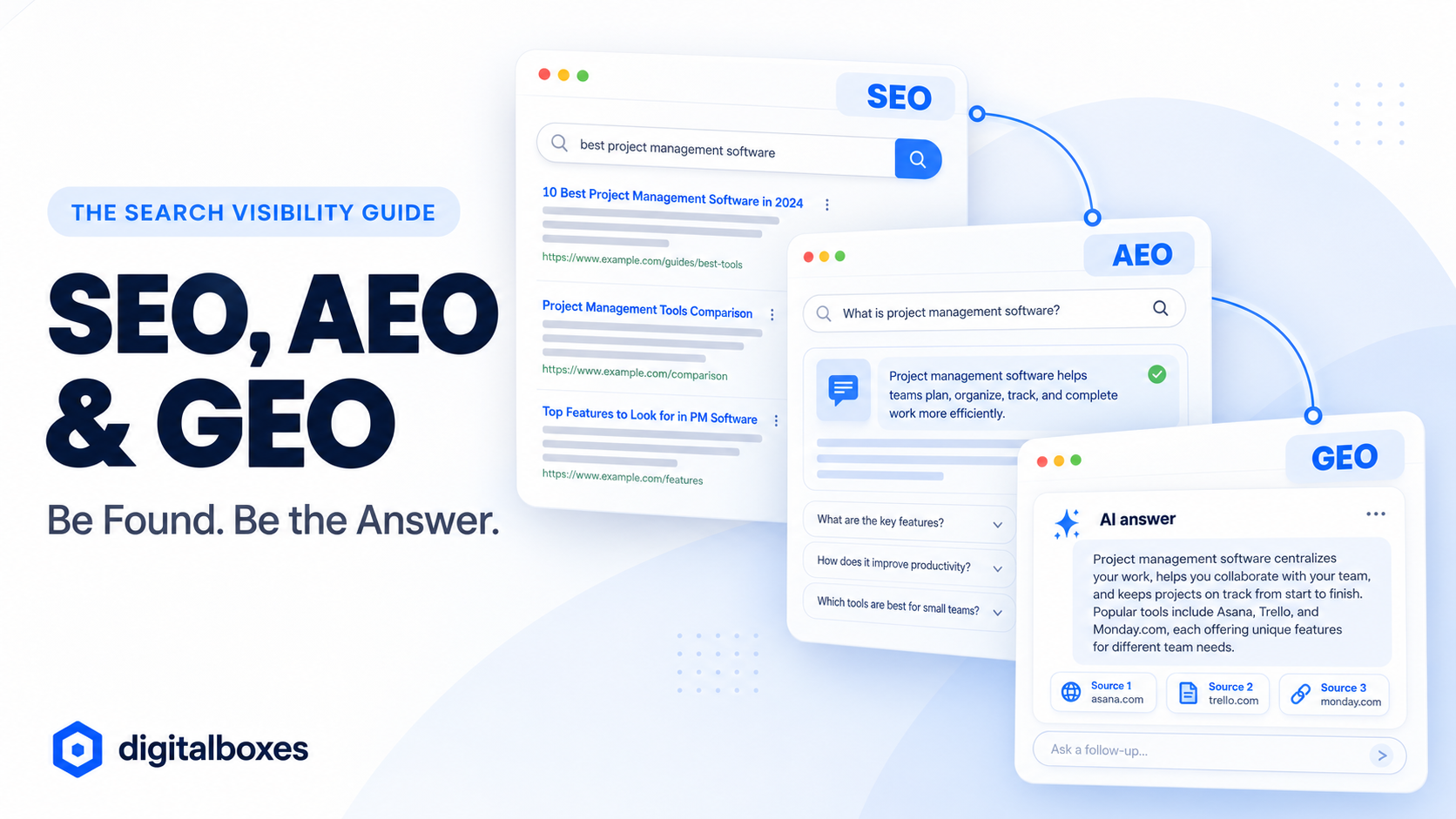
AI SEO, AEO and GEO are not three separate strategies competing for your attention. They are three layers of the same search visibility system, and in 2026 you need all three working together. This framework gives you a complete, practical structure for ranking on Google, getting cited inside ChatGPT and Perplexity answers, and building the brand authority that makes AI engines trust and recommend you over competitors.
1. How Search Has Changed in 2026
The shift that makes a unified AI search framework essential right now.
The era of ten blue links is ending. According to Serpent API's analysis of Google's May 2026 AI Features guide, the search experience in 2026 is no longer a static ranked list. It is an AI-synthesized feedback loop where the goal is not to rank but to be the definitive source of truth that an AI pulls into its answer.
This shift has created three distinct visibility challenges that did not exist together before. You need to rank in traditional Google results, appear inside AI-generated answer cards, and be trusted enough by AI systems that they cite you by name when multiple competing sources exist. Each of these requires a different optimisation layer but they all run on the same content foundation.
93%
Of AI searches end with zero clicks to any website according to Semrush data
433%
Brand citation improvement HubSpot achieved by implementing AEO systematically
50%+
Of marketers already optimising content for answer engines per HubSpot's State of AEO 2026
Google's Official Position: Google's own AI Features guidance states "there is nothing about creating content for AI features that fundamentally differs from creating content for any other Google Search surface." These are not replacements for SEO. They are extensions of it.
2. The Three Layers Explained
How SEO, AEO and GEO relate to each other in one unified system.
Think of the full optimisation framework as three concentric layers. Each layer depends on the one beneath it. Skipping to GEO without solid SEO foundations is like building a floor without walls.
SEO - Search Engine Optimisation (The Foundation)
Ranking your pages in traditional Google results. Keywords, on-page optimisation, technical health, backlinks, and E-E-A-T signals. Still the foundation. Still required. AI systems rely on the same crawl and index infrastructure as traditional search.
Goal: Rank in traditional Google search results
AEO - Answer Engine Optimisation (The Page Layer)
Structuring your content so AI systems can extract it as a clean, citable answer. This is the page-craft layer - how you write, structure, and format content so LLMs can parse and quote it accurately. The difference between AEO and SEO is the difference between ranking and being cited inside the answer itself.
Goal: Get extracted and cited inside AI-generated answers
GEO - Generative Engine Optimisation (The Brand Layer)
Building the brand authority signals that make AI engines trust you over competing sources. When five websites all provide a similar answer, GEO determines which one gets cited. This is the brand-and-trust layer built through entity consistency, third-party mentions, structured data, and authoritative external signals.
Goal: Be the trusted source AI engines recommend by name
3. Layer 1 - Traditional AI-Enhanced SEO
The non-negotiable foundation that everything else depends on.
Traditional SEO did not become irrelevant when AI search arrived. It became more important because AI systems use the same Google crawl infrastructure to discover, index, and evaluate content. According to Gracker's 2026 GEO framework, the shift from keyword optimisation to entity optimisation is the most significant SEO evolution of this era.
- 1Entity optimisation over keyword stuffing: AI systems understand entities, not just keywords. Your pages should clearly establish what your brand is, what it does, who it serves, and where it operates. Entity clarity across all pages helps AI systems build an accurate knowledge graph entry for your brand.
- 2E-E-A-T signals at every level: Experience, Expertise, Authoritativeness, and Trustworthiness are the quality signals Google's systems and AI systems use to evaluate content quality. Author bios, first-person experience, data citations, and external authority links all contribute.
- 3Topic authority over individual page ranking: Build clusters of related content that establish your site as the authoritative source on a topic. AI systems evaluate domain authority on a topic level, not just page by page. See our guide on AI SEO and LLM Optimisation for more on content clusters.
- 4Technical health is non-negotiable: Crawlability, page speed, Core Web Vitals, and mobile optimisation are table stakes. AI crawlers cannot extract content from broken or slow pages.
- 5Structured data across all page types: Schema markup helps both traditional Google and AI search systems understand the type, author, date, and context of every piece of content. Article, FAQPage, HowTo, and Product schema are the highest-priority types for most businesses.
4. Layer 2 - AEO: Answer Engine Optimisation
The page-craft layer that gets your content extracted and cited inside AI answers.
According to a 12,400-query analysis of AI answer citations across ChatGPT, Perplexity, Google AI Overviews, and Gemini, Answer Engine Optimisation has become the most important new SEO discipline since structured data. The primary KPI has shifted from click-through to page to citation in AI answer.
The seven answer-shape patterns that AI engines lift most consistently:
The Statistics Pattern
A single-sentence stat with a named source. Statistics-anchored content is cited at 3.4 times the baseline rate. Example: "According to HubSpot's State of AEO 2026, more than 50% of marketers are already optimising content for answer engines."
The Definition Pattern
A clear, one-sentence definition followed immediately by practical context. Every piece of content covering a technical topic should open with a definition pattern for the primary term before expanding into detail.
The Structured List Pattern
Pages structured around tables and lists are 1.7 times more likely to be cited because they are easier for LLMs to parse as discrete data points. Numbered steps, comparison tables, and bullet-point frameworks all activate this pattern.
The FAQ Pattern
FAQPage schema covering the most likely follow-up questions, with question text matching the H3 heading and answer text matching the visible paragraph below it. AI systems use FAQ sections as high-confidence answer extraction targets.
The How-To Pattern
Step-by-step instructions with a clear outcome stated upfront. HowTo schema markup makes these extractable by AI systems as structured process answers rather than just narrative text.
The Comparison Pattern
Structured comparison tables between options, tools, or approaches. When users ask AI systems to compare two things, engines preferentially cite pages that already contain a formatted comparison rather than assembling one from narrative text.
The First-Party Data Pattern
Original research, surveys, case studies, or unique data that cannot be found anywhere else. AI engines prioritise first-party data because it provides genuinely unique information rather than rephrasing what already exists across hundreds of competing pages.
5. AEO Tactics That Get You Cited
Practical implementation steps for every page on your site.
According to the 210-brand AEO audit, the most common reasons pages are not cited despite ranking well in traditional search are: burying the answer below 600 words of brand introduction, writing claims without naming a source, and trying to answer five questions on one page so no single question gets a clean answer span.
AEO Implementation Checklist:
- ✅Answer-first opening: Put your definitive answer in the first 1 to 2 sentences. Not "in this article we will explore" - the actual answer, stated clearly and completely before any supporting context.
- ✅Name every source: Write "According to HubSpot's 2026 State of AEO report" not "according to research." Named sources give AI engines a clean citation span to lift with attribution intact.
- ✅One question per section: Each H2 or H3 heading should ask and answer exactly one question. Multi-question sections dilute the answer signal and reduce citation likelihood significantly.
- ✅Add FAQPage schema to every FAQ section: Every FAQ section on your site should have corresponding FAQPage structured data markup. This is one of the highest-impact AEO technical changes with a very low implementation cost.
- ✅Use tables for comparisons: Any comparison of two or more options should appear as a structured table, not narrative prose. Tables are parsed more reliably by LLMs and cited more frequently in comparison queries.
- ✅Include a concise TL;DR at the top: A 3 to 5 bullet summary of your article's key conclusions gives AI engines a clean extraction target for queries where a summary answer is sufficient.
6. Layer 3 - GEO: Generative Engine Optimisation
The brand authority layer that determines which source AI engines trust when multiple good answers exist.
According to Gracker's 2026 GEO framework, success in generative search is now measured by citation frequency in AI-generated responses rather than by click-through from ranked results. Content must be structured to answer granular user queries for retrieval systems, and the strategy must shift from click-baiting to providing authoritative and fact-dense answers.
Where AEO is about how you write your pages, GEO is about how your brand is perceived across the entire web. AI engines triangulate brand authority across third-party sources, mentions, reviews, structured data, social proof, and trusted publications before deciding whether to include you in an answer.
GEO Brand Signals
- - Consistent entity name across all platforms
- - Wikipedia or Wikidata presence
- - Google Business Profile completeness
- - Third-party review mentions
- - Industry publication citations
- - Social media profile consistency
- - Author authority on published content
GEO Content Signals
- - Original research and data
- - Expert quotes from named sources
- - Case studies with measurable outcomes
- - brand-facts.json file implementation
- - Consistent topical coverage over time
- - External backlinks from authority domains
- - Podcast appearances and interviews
7. GEO Tactics for Brand Authority
Building the trust signals that make AI engines recommend you by name.
GEO Implementation Checklist:
- ✅Entity consistency across all platforms: Your brand name, description, logo, and core service claims should be identical across your website, Google Business Profile, LinkedIn, social media, and directory listings. Inconsistency creates entity ambiguity that AI systems resolve by citing cleaner competitors.
- ✅Publish original data regularly: First-party surveys, client outcome data, and industry analyses give AI engines unique content to cite that cannot come from anywhere else. Even a simple annual survey of your client base creates citable first-party data.
- ✅Build your author's entity: Named authors with consistent biographical information, LinkedIn profiles, and cross-publication bylines signal human expertise to AI evaluation systems. Anonymous or unclear authorship reduces GEO trust signals significantly.
- ✅Earn coverage in trusted publications: A single mention in a high-authority industry publication carries more GEO weight than ten links from low-authority sites. Target digital marketing publications, Pakistan business media, and industry directories for coverage.
- ✅Get client reviews on trusted platforms: Google Business Profile reviews, Clutch.co reviews, and LinkedIn recommendations all feed into AI systems' brand trust evaluation. Reviews mentioning specific services and outcomes are more valuable than generic praise.
- ✅Implement Organization schema sitewide: Organization structured data on every page establishes your entity's name, description, founding date, social profiles, and contact information in machine-readable format that AI crawlers prioritise.
8. Technical Setup for AI Search
The technical infrastructure that makes your site accessible and trustworthy to AI crawlers.
According to Context Studios' AEO and GEO technical guide, the 2026 technical stack combines Google AI features readiness, structured data, AI crawler controls, llms.txt, and brand-facts.json.
llms.txt - Tell AI Crawlers What Matters
Create a plain text file at yourdomain.com/llms.txt listing your priority pages with short descriptions of each. This signals to AI crawlers which content represents your most authoritative material on each topic.
> AI-powered SEO, digital marketing, and automation services
## Core Services
- [SEO Services](https://digitalboxes.net/services/): AI-powered SEO for Pakistani businesses
Schema Markup Priority Stack
Implement these schema types in priority order: Organization (all pages), Article (all blog posts), FAQPage (all FAQ sections), BreadcrumbList (all pages), and HowTo (all step-by-step guides). Each type signals structured information to both traditional and AI search systems.
AI Crawler Access in robots.txt
Ensure you are not accidentally blocking AI crawlers in your robots.txt. ChatGPT uses GPTBot, Perplexity uses PerplexityBot, Google AI Overview uses Googlebot. Blocking any of these prevents citation regardless of how well your content is optimised.
Allow: /
User-agent: PerplexityBot
Allow: /
brand-facts.json
A machine-readable JSON file at yourdomain.com/brand-facts.json stating key brand facts. Name, founding date, service areas, key personnel, and company description in a format AI systems can reliably extract and cite.
9. The Answer-First Content Framework
How to structure every piece of content for maximum AI citation potential.
The answer-first framework applies to every piece of content you create - blog posts, service pages, FAQs, and landing pages. The single biggest reason well-ranking pages are not cited by AI systems is burying the answer below extensive introductory content.
Answer-First Page Structure:
Clear question or topic statement that matches the search query exactly
Definitive 1 to 2 sentence answer in the opening paragraph. Statistic with named source if available.
3 to 5 bullet summary of key conclusions for queries where a quick answer is sufficient
Each H2 answers one specific sub-question. Opened with a definitive answer sentence before supporting detail.
FAQPage schema section covering the 5 to 8 most likely follow-up questions with concise, source-cited answers
What Kills Your AEO Citation Potential:
- Opening with "In this article we will explore..." before giving the answer
- Making claims without naming a source so AI has no clean citation span
- Covering 5 questions in one section so no single question gets a clean extraction
- Writing in flowing narrative where key facts are embedded in long paragraphs
- Using hedging language like "it might be" or "some people think" instead of direct answers
10. How to Measure AI Search Visibility
The metrics that replace traditional ranking position in an AI-search world.
Traditional rank tracking does not capture AI citation visibility. You need a different measurement framework that tracks where and how often your brand and content appear inside AI-generated answers.
| Metric | How to Measure | Target |
|---|---|---|
| AI referral traffic | GA4 - filter by source containing ChatGPT, Perplexity, Claude | Growing month over month |
| Brand citation rate | Manually query target keywords in ChatGPT, Perplexity, Gemini monthly | Cited in 30%+ of relevant queries |
| AI Overview appearances | Google Search Console - Search Appearance filter for AI Overviews | Increasing impressions |
| Direct brand searches | GSC - filter queries for brand name | Growing after AI citation activity |
Free Measurement Method: Create a spreadsheet of your 20 most important target queries. Query each one monthly in ChatGPT, Perplexity, and Google AI Mode. Record whether your brand or content is cited. Track the percentage of queries where you appear over time. This manual approach costs nothing and gives you genuine AI visibility data before investing in paid monitoring tools.
11. 90-Day Implementation Plan
A practical week-by-week roadmap for implementing all three layers.
Month 1 - Technical Foundation and SEO Layer
- Audit and fix all missing or duplicate meta tags across your site
- Implement Organization, Article, and FAQPage schema on all relevant pages
- Create and publish your llms.txt file
- Verify AI crawlers are not blocked in robots.txt
- Identify your 20 highest-priority target queries for AI visibility tracking
- Conduct baseline measurement of current AI citation rate for target queries
Month 2 - AEO Content Layer
- Rewrite your 10 highest-traffic pages using the answer-first framework
- Add TL;DR summary sections to all major blog posts
- Add FAQPage schema to every page with a FAQ section
- Replace narrative comparisons with structured comparison tables
- Add named source citations to all statistics and claims
- Publish at least one piece of original first-party research or data
Month 3 - GEO Brand Authority Layer
- Audit entity consistency across all platforms and correct any inconsistencies
- Complete and verify your Google Business Profile
- Pitch one industry publication for a guest post or expert quote
- Collect and publish at least 5 new verified client reviews on Google
- Build out author bio pages for all named contributors to your content
- Measure AI citation rate improvement versus Month 1 baseline
12. Frequently Asked Questions
Q: What is the difference between SEO, AEO and GEO?
SEO optimises your content to rank in traditional Google search results. AEO optimises your content to be extracted and cited as a direct answer by AI systems. GEO optimises your brand authority so AI engines trust and recommend you over competitors. All three are required for full search visibility in 2026.
Q: Does traditional SEO still matter in 2026?
Yes. Google's own May 2026 guidance confirmed that there is nothing about creating content for AI features that fundamentally differs from creating content for traditional search. Traditional SEO remains the foundation. AEO and GEO build on top of it rather than replacing it.
Q: How do I get my content cited by ChatGPT and Perplexity?
Content cited by ChatGPT and Perplexity shares four characteristics: it provides a clear, definitive answer in the opening paragraph, it includes original data or statistics with named sources, it uses structured formats like tables and lists that LLMs can parse easily, and the publishing domain has consistent entity authority signals across the web.
Q: What is llms.txt and does my website need it?
llms.txt is a plain text file placed at yourdomain.com/llms.txt that tells AI crawlers which pages to prioritise when building their knowledge about your site. It functions similarly to robots.txt but for large language models. Adding it is a quick technical win that helps AI systems understand your most important content faster.
Q: How long does it take to see results from AEO and GEO?
AEO changes to existing pages can show results in 2 to 4 weeks as AI crawlers re-index updated content. GEO brand authority signals typically take 60 to 90 days to build meaningfully. A combined AI SEO, AEO and GEO strategy typically shows measurable citation improvement within 90 days.
Q: What is the most important ranking factor for AI search in 2026?
According to a 12,400-query analysis, statistics-anchored content with named sources is cited at 3.4 times the baseline rate. Pages structured around tables and lists are 1.7 times more likely to be cited. The single most important factor is providing a clean, definitive answer in the first 1 to 2 sentences before any supporting context.
Sources and Further Reading
- -Serpent API - GEO vs AEO vs SEO: Google's 2026 AI Search Guide Explained
- -Visionary Marketing - AEO Statistics 2026: A 12,400-Query Analysis
- -HubSpot - The State of AEO in 2026
- -Gracker - The Future of Search: A Complete Guide to AEO and GEO for 2026
- -Context Studios - Answer Engine Optimization and GEO Complete Guide 2026
- -Brenton Way - AEO Statistics for 2026: AI Search, Zero-Click Trends and Strategy
Conclusion
AI SEO, AEO and GEO are not three competing frameworks. They are three layers of the same visibility system operating at different levels - your pages, your content structure, and your brand authority. Businesses that treat them as separate disciplines end up with technically optimised pages that AI engines cannot extract and a brand that ranks well in Google but never gets cited when customers ask ChatGPT or Perplexity for recommendations.
The unified framework is straightforward. Build your SEO foundation so AI crawlers can find and index your content. Apply AEO principles so the content is structured in extractable, citable formats. Build GEO authority so AI engines trust your brand enough to cite it by name when multiple competing answers exist. Then measure all three layers systematically rather than only tracking traditional search rankings.
The 90-day plan in this guide covers all three layers in a practical sequence that any business can execute without a large team or budget. The technical changes take days. The content restructuring takes weeks. The brand authority takes months. Start with the technical foundation today and the compounding visibility improvement will follow.
Found this framework useful? Share it with a marketing team still running a traditional SEO-only strategy. Explore more AI search, digital marketing, and automation guides at Digitalboxes.net.