Agentic AI - Complete Marketing Guide
Agentic AI Personalization - Complete Marketing Guide
Agentic AI personalization is the next leap beyond rule-based segmentation. AI agents now observe customer behavior in real time, make autonomous decisions, and deliver individualized experiences at a scale no human team can match. According to Gartner, 60% of brands will use agentic AI to deliver one-to-one customer interactions by 2028. This guide explains how it works, what it replaces, and how to implement it without losing customer trust.
1. What Is Agentic AI Personalization
The shift from rule-based segments to autonomous, real-time individual decisions.
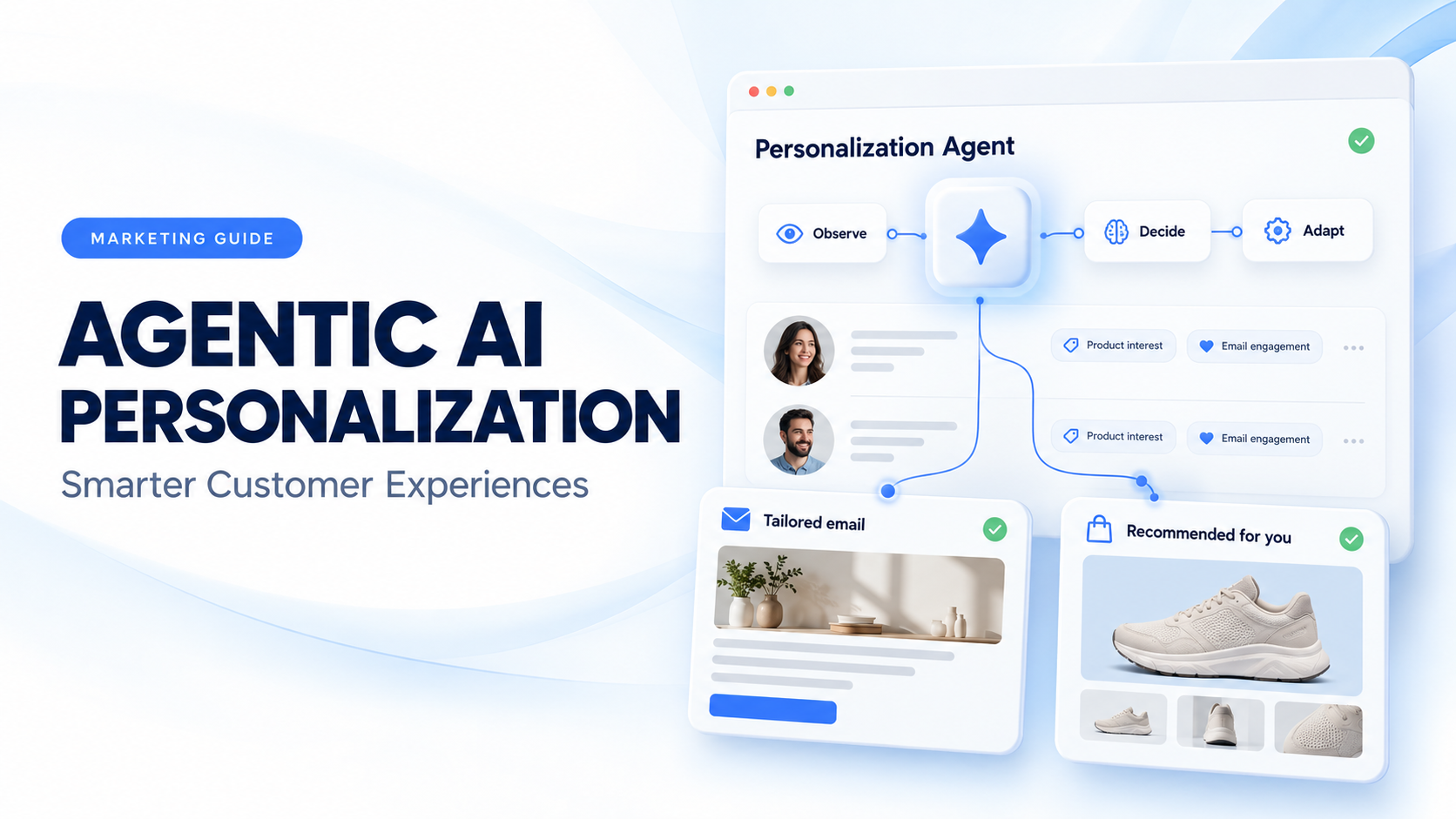
Agentic AI personalization is the use of autonomous AI agents to observe, decide, and act on individual customer data in real time - without requiring a human to define rules for each scenario in advance. Traditional personalization follows if-then logic: if a customer is in segment A, show them message B. Agentic AI replaces that with continuous learning: the agent monitors behavior, infers intent, selects the next best action, and delivers it - then observes the outcome and adjusts.
According to Gartner's January 2026 research, 60% of brands will use agentic AI to deliver streamlined one-to-one customer interactions by 2028. Gartner Senior Principal Researcher Emily Weiss describes this as "the end of channel-based marketing as we know it" - a shift where AI agents replace static campaign calendars with persistent, adaptive customer relationships.
60%
of brands will use agentic AI for 1:1 marketing by 2028 (Gartner)
25%
higher conversion rates from AI personalization within 6 months (Salesforce)
71%
of consumers expect personalized interactions (McKinsey)
2. Agentic AI vs Traditional Personalization
What changes, what it replaces, and why the gap matters.
Traditional personalization tools - email segment rules, product recommendation engines, dynamic website blocks - work well when customers behave predictably within predefined segments. They fail when customer journeys become non-linear, multi-channel, and context-dependent.
Agentic AI systems handle this by maintaining a persistent model of each individual customer - their history, current session behavior, inferred intent, and likely next action - and using that model to select the most relevant experience at every touchpoint, across every channel, simultaneously.
| Dimension | Traditional Personalization | Agentic AI Personalization |
|---|---|---|
| Decision model | Human-defined rules and segments | Autonomous agent learns and decides |
| Update frequency | Batch updates (daily or weekly) | Real-time, per-session or per-action |
| Scope | One channel at a time | Cross-channel, coordinated |
| Scale | Segment-level (thousands) | Individual-level (millions) |
| Human role | Defines every rule manually | Sets goals, reviews outcomes, maintains guardrails |
| New scenario handling | Falls back to default | Agent infers best action from context |
3. How Agentic AI Personalization Works
The four-stage loop that replaces campaign calendars.
Agentic AI personalization runs on a continuous observe-decide-act-learn loop. Each stage happens autonomously, often in milliseconds, across millions of customer interactions simultaneously.
Observe
The agent ingests real-time signals: page visits, click patterns, scroll depth, time on page, purchase history, email opens, support tickets, and CRM data. It builds a live customer model that updates with every interaction.
Decide
Using the live customer model and the goal it has been given (conversion, retention, upsell, support deflection), the agent selects the next best action from the available options: which message, which product, which channel, which timing.
Act
The agent executes the decision autonomously - sending an email, changing a website hero, triggering a chat message, adjusting an ad bid, or routing the customer to a specific support flow - without waiting for human approval.
Learn
The agent records the outcome of each action and updates its decision model. Actions that drove the desired outcome are weighted more heavily in future decisions. This is what separates agentic AI from static recommendation engines - the system improves continuously from live results.
4. Real-World Use Cases
Where agentic AI personalization is already delivering measurable results.
Agentic AI personalization is not a future concept. Amazon attributes 35% of its annual sales to its AI recommendation engine, which personalizes product suggestions for hundreds of millions of customers in real time. Netflix's recommendation system, which drives 80% of content viewed, uses a similar autonomous approach - continuously learning from watch behavior to surface the next most relevant title for each individual user.
For marketing teams, the most practical current applications are:
Email and Push Timing
AI agents determine the optimal send time for each individual subscriber based on their historical engagement patterns, not a single broadcast time. AI-personalized emails show 29% higher open rates and 41% higher click-through rates compared to standard sends (Loop Ex Digital).
Website Content Personalization
Agents adjust hero images, CTAs, product order, and copy in real time based on the visitor's referral source, behavior history, and predicted intent - turning a single website into millions of individualized experiences simultaneously.
Product Recommendations
AI agents move beyond "customers also bought" to predict what this specific customer needs next based on their full history, current session, and real-time signals. Personalized product recommendations drive up to 31% of e-commerce revenue in sessions where customers engage with them (Barilliance).
Churn Prevention
Agents monitor engagement signals that predict churn - declining email opens, reduced login frequency, support ticket patterns - and autonomously trigger retention interventions: personalized offers, success calls, or feature education sequences.
Ad Audience Optimization
AI agents continuously adjust ad targeting, creative selection, and bid levels based on real-time conversion data - moving budget toward the combinations that work and away from those that do not, without waiting for a weekly review.
Conversational Personalization
AI chat agents personalize conversations using the customer's history, current page context, and inferred intent. Customers with a support history get different routing than first-time visitors. High-intent visitors get different CTAs than browsers.
5. Tools and Platforms for Agentic AI Personalization
The platforms enabling autonomous personalization at scale in 2026.
The agentic AI personalization stack in 2026 spans three layers: data unification, decision intelligence, and execution channels. Most enterprise platforms now combine all three.
| Platform | Primary Use | Best For |
|---|---|---|
| Salesforce Agentforce | Autonomous sales and service agents with CRM data | B2B, enterprise |
| Braze | Cross-channel customer engagement with AI timing and content | Mobile-first brands, e-commerce |
| Relevance AI | Custom AI agent builder for marketing workflows | Agencies, mid-market teams |
| Adobe Real-Time CDP | Real-time customer profiles for cross-channel activation | Enterprise, omnichannel |
| HubSpot AI | AI-powered CRM with smart content and email personalization | SMBs, inbound-led teams |
| GoHighLevel | AI-driven funnels, CRM, and automated follow-up sequences | Agencies, local businesses |
For small businesses and agencies in Pakistan, GoHighLevel and HubSpot offer the most accessible entry points into agentic AI personalization without enterprise-level investment. See our GoHighLevel Automation Framework guide for a practical setup walkthrough.
6. How to Implement Agentic AI Personalization
A practical 5-step framework for teams starting from scratch.
Personalization drives a 5% to 15% revenue lift, with some implementations reaching 25% according to McKinsey - but only when the underlying data foundation is in place. Most failed personalization projects fail at step 1, not step 5.
Unify your customer data
An AI agent is only as good as the data it can observe. Connect your CRM, website analytics, email platform, e-commerce data, and support system into a single customer profile. Without unified data, agents make decisions with incomplete context and produce worse results than simple rules.
Define goals and guardrails
Tell your AI agents what success looks like - conversion rate, retention rate, average order value, support deflection - and set explicit guardrails: messaging tone, content categories to avoid, frequency caps, channels the agent can and cannot use. Agents optimize for whatever goal you give them; an unclear goal produces unpredictable behavior.
Start with one high-value use case
Do not try to personalize everything at once. Pick one use case with clear measurement: email send-time optimization, product recommendations on the cart page, or churn-triggered retention sequences. Build confidence in the system's performance before expanding its scope.
Run controlled tests against your baseline
Split traffic: have the AI agent handle one group while your existing approach handles the control group. Measure conversion, revenue, and engagement differences over at least 4 weeks before drawing conclusions. This tells you exactly what the agent is adding and prevents you from attributing seasonal lifts to AI decisions.
Monitor, audit and expand
Gartner recommends tracking customer journey changes weekly when running agentic AI systems. Review the decisions agents are making regularly - not to micromanage every action but to catch cases where the agent has learned a pattern that optimizes for your metric but not for the customer relationship. Then expand to additional use cases once the first is stable.
7. Trust, Privacy and Ethics in Agentic AI Personalization
Why trust metrics are replacing engagement metrics as the measure of personalization success.
Gartner's research is explicit: marketing success in the agentic AI era is moving from engagement metrics to trust metrics. In a Gartner Consumer Community survey of 335 U.S. consumers, 78% said explicit labeling of AI-generated content is very or most important for maintaining trust. Personalization that feels accurate and helpful builds loyalty. Personalization that feels intrusive or invisible destroys it.
Trust-building practices
- - Label AI-generated recommendations clearly
- - Give customers control over their data and preferences
- - Use first-party data as the primary personalization signal
- - Set frequency caps to prevent message fatigue
- - Make opt-out simple and immediate
- - Explain why a customer is seeing a specific recommendation
Trust-destroying practices
- - Using third-party data without explicit consent
- - Personalizing based on sensitive inferences (health, finances)
- - Showing a customer that you know too much too soon
- - Allowing agents to contact customers on channels they did not opt into
- - Optimizing for short-term conversion at the expense of relationship quality
- - No human review of AI decisions that affect high-value customers
76% of consumers are frustrated when personalization expectations go unmet (McKinsey) - but poorly executed personalization can be worse than no personalization at all. Customers who receive preference-based personalization have 33% higher lifetime value (WiserNotify). The goal is personalization the customer notices as relevant, not surveillance they notice as uncomfortable.
8. Common Agentic AI Personalization Mistakes
The errors that turn personalization investments into customer complaints.
-
✗
Skipping data unification: Running an agentic AI system on siloed data produces decisions that contradict each other across channels. A customer who just purchased seeing an ad for the same product is a data-unification failure, not an AI failure.
-
✗
Giving agents unclear goals: "Maximize engagement" will produce agents that send more messages. "Maximize revenue" without guardrails will produce agents that push high-margin products to every customer regardless of fit. Specific, constrained goals produce predictable, useful behavior.
-
✗
No human review loop: Autonomous does not mean unsupervised. Agents can optimize into local maxima that hurt the brand. Weekly audits of the decisions an agent is making - especially for high-value or sensitive segments - prevent systematic errors from scaling.
-
✗
Measuring only short-term conversion: An agent that pushes discounts to every high-intent customer will show strong conversion numbers and destroy margin and price perception over time. Measure lifetime value, repeat purchase rate, and net promoter score alongside conversion.
-
✗
Launching across all channels at once: Cross-channel agentic personalization requires coordinated data and decision systems. Starting with email or web alone gives you a working foundation before adding SMS, push, ads, and chat. Launching everywhere simultaneously multiplies the failure surface.
9. Frequently Asked Questions
Q: What is agentic AI personalization?
Agentic AI personalization is the use of autonomous AI agents to observe individual customer behavior in real time, decide the next best action for each customer, execute that action across marketing channels, and continuously learn from outcomes - without requiring human-defined rules for each scenario. It replaces static segmentation with individual-level decision-making at scale.
Q: How is agentic AI different from traditional marketing automation?
Traditional marketing automation follows fixed if-then rules that humans define in advance. Agentic AI systems learn from data, infer intent, and make decisions the human never explicitly programmed. They also act across multiple channels simultaneously and improve their own decision-making from observed outcomes, which automation tools do not do autonomously.
Q: Is agentic AI personalization only for large enterprises?
No. Platforms like HubSpot and GoHighLevel now offer AI-powered personalization features accessible to small and mid-sized businesses. The data requirements are lower than enterprise deployments, and the use cases - email timing, product recommendations, lead scoring - produce measurable results without a large data science team.
Q: What data does agentic AI personalization require?
At minimum: behavioral data (page visits, clicks, purchases), identity data (email, customer ID), and engagement history (email opens, session frequency). More powerful personalization adds CRM data, support history, and real-time session signals. The key requirement is that data from different sources is unified into a single customer profile the agent can observe.
Q: How do I measure the ROI of agentic AI personalization?
Run controlled tests: split customers into an AI-personalized group and a control group, then measure conversion rate, average order value, repeat purchase rate, and email engagement over at least 4 weeks. McKinsey reports personalization typically drives a 5% to 15% revenue lift and 10% to 30% improvement in marketing efficiency - use these as benchmark expectations for your own tests.
Q: What are the privacy risks of agentic AI personalization?
The main risks are using data customers did not consent to share, personalizing based on sensitive inferences (health status, financial situation), and contacting customers on channels they did not opt into. Mitigate these by relying on first-party data, giving customers preference controls, labeling AI-generated content explicitly, and setting channel and frequency guardrails agents cannot override.
Sources and Further Reading
- - Gartner - 60% of Brands Will Use Agentic AI for One-to-One Interactions by 2028 (January 2026)
- - SHNO - AI Personalization Statistics: Conversion Rates, Revenue Impact and Customer Expectations
- - Braze - Real-World Agentic AI Examples in Marketing
- - Relevance AI - AI Agent Examples in Marketing Personalization
- - Konabayev - AI Agents for Marketing: Statistics and Benchmarks 2026
Conclusion
Agentic AI personalization is not a tool upgrade - it is a fundamental change in how marketing decisions get made. The shift from human-defined segments to autonomous per-customer decisions, updating in real time across every channel, is what Gartner means by "the end of channel-based marketing." Brands that build the data infrastructure, set clear goals, and implement agentic systems on one use case at a time will outpace competitors still running batch-update segmentation.
The results are measurable: McKinsey's research shows 5% to 15% revenue lift, Salesforce reports 25% higher conversion rates within six months, and Amazon's 35% revenue attribution to its recommendation engine is the most cited proof point in the industry. These numbers reflect systems that have been running for years. Starting now means your system will be maturing while competitors are still evaluating.
Start with unified customer data, pick one high-value use case, run a controlled test, and expand from there. The investment in agentic AI personalization compounds - every decision the agent makes teaches it to make better decisions next time.
Explore more AI marketing, SEO, and automation guides at Digitalboxes.net - or read our AI SEO, AEO and GEO Framework to see how agentic personalization fits your broader AI marketing strategy.